
January 16, 2026


OK, we’re back for part two of my review of the year in film, with some of my favorites from 2025. If you missed part one, you can find it here. This week, I’ll be sharing some of my favorite documentaries that I saw over the last twelve months and next week I’ll begin my countdown of my top 20 films of the year.
When it comes to the world of documentaries, you usually get three different kinds. The first are ultra serious examinations of an important topic. I tend to watch a number of these, but depending on the topic, I might just not be up for it. For instance, there have been several quality films about the war in Ukraine over the last few years, but after a certain point, I just can’t handle another one. The second category is the portrait of an individual that is told by a quality director who takes a critical look at the good and bad of the subject. These can be tricky, because you don’t really know what you are getting into until you start watching the film. Now, I don’t need a hit piece, but if it’s a puff piece that feels like a commercial for the subject of the movie, then I’m not interested. And that’s the third type of documentary we typically see and unfortunately, these are becoming more frequently produced. My tip – if the subject of the story is an executive producer on the movie, it’s probably a puff piece.
We’re going to start this post with a profile of an investigative journalist who had an incredible impact not only on the journalism profession, but on this country, and the film unfortunately served as a reminder of the sad state of journalism today.
Tell It Like You See It – Cover-Up
One of the more interesting aspects about Cover-Up, a portrait of investigative journalist Seymour Hersh, is a statement early in the film from directors Laura Poitras and Mark Obenhaus. They’ve been trying to make this movie for several years, but they could never get Hersh to cooperate. He finally agreed to be interviewed, but there were times you could feel him thinking, “What’s the big deal? I found a story, I chased it, I wrote it, and moved on to the next thing. Why do you care?” He was simply a reporter who wanted to do good work.
Hersh has been a model of investigative journalism for almost sixty years. He came to prominence with his reporting of the My Lai Massacre during the Vietnam War, exposing the Federal government’s cover-up of the incident. He went on to report on several other notable events of the 20th century, including Watergate, covert actions by the CIA, and the Iraq War. His reporting of prisoner abuses at Abu Ghraib broke open a massive scandal in the post-9/11 war on terror. As good as he was, Hersh was not without controversy. He missed the mark on a few stories and he discusses his mistakes and shortcomings in the documentary. That’s one of the aspects of this film that I liked – the subject is not perfect and he is not presented that way.
Poitras and Obenhaus did a terrific job in assembling the details for this film, getting candid comments from Hersh about the key events in his life, while supplementing his words with archival footage and interviews with other reporters. In addition to the type of documentary that piques my interest, I also look for the director’s pedigree. Poitras has a strong track record with her films, including the great look at Edward Snowden in 2014’s Citizenfour and All the Beauty and the Bloodshed, one of the best documentaries of 2022, which examined the life of artist and activist Nan Goldin. It’s safe to say that whenever she has a new project, I’ll be checking it out. Cover-Up is now streaming on Netflix.
Real Heroes – The Librarians
One of the more infuriating atrocities since fascism seems to have gained some kind of popularity in this country over the last ten years is the ridiculous assault on what books are allowed in schools. You have no doubt seen the stories of small towns across America declaring war on any book they deem inappropriate for their children. 99.999% of the time these books are about (or just contain small passages of) the topic of race or anyone in the LGBTQ population. People with too much power and wayyyyyyy too much time on their hands decided that these books needed to be removed from school libraries because they were poisoning the minds of kids in their town (their words, not mine).
The Librarians is an examination of this issue at a macro level, to get the viewer informed on the issue, showing the roots of how this grew from small discussion topics on Facebook to a national movement backed by multi-million dollar organizations. But more impactfully, the film looks at specific teachers in Florida, Texas and Louisiana who fought back against these actions, sometimes at the risk of their career and even their personal safety. This is a film that truly speaks to the moment we are living in now, the danger of giving power to people who have only one way of thinking about the world and can’t even fathom someone living a different lifestyle than them.
I saw this movie several months ago and it still infuriates me when I think about the examples of abhorrent behavior on display. I remember shaking my head several times in the theater, pondering “What the fuck are these people thinking?” But I also try to remember the courage of the librarians who stood up to the authorities and declared “This is wrong – we have to fight back.” Sadly, this battle is far from over, but I’m glad there are still some decision makers in this country who have their heads screwed on right. Look for The Librarians on PBS, beginning February 9th.
Difficult Topics, Excellent Documentaries – Predators and The Perfect Neighbor
I was fortunate to catch these two selections as part of the virtual Sundance Film Festival about a year ago. I thought going in that they might be a tough watch, but hoped that the experience of watching them would be rewarding because I could see two talented filmmakers tackle a difficult topic in an impressive way. I was right.
First up is Predators, an exploration of the NBC television show To Catch A Predator, a spinoff of Dateline NBC that focused on catching criminals who were preying on children. The show dives into how the show (which only ran for three years – I thought it aired longer) was conceived, and the tactics the producers employed to find and recruit the criminals to a house. They showed up thinking they were meeting a child for a sexual encounter, but were met by host Chris Hansen. What transpired next varied from individual to individual. Some tried to run out of the house, only to be arrested by the police outside. Some thought it was a joke. Some broke down in tears. And the truly psychotic ones didn’t really see a problem with their actions.
This documentary can be quite disturbing, but if you are familiar with the original show, it won’t be too surprising. One of the interesting aspects of the film was the footage of To Catch a Predator being discussed on talk shows in the early 2000s, with the hosts joking about the men being arrested. I’m sure people found it funny 20 years ago, but looking back on it, it’s quite disturbing. The film is also an interesting time capsule into the world of true-crime television, which is extremely popular now (just look at the top ten lists on Netflix), but not for me. While I love a good thriller, I never got into the true-crime shows. They feel exploitative. Maybe knowing that the events really happened bothers me, compared to a fictional story I can see in a movie. Credit goes to Predator director David Osit for securing an interview with Chris Hansen about his time hosting the show, the infamous episode that led to it being canceled, and his current gig, which (you guessed it) involves chasing online predators. Predators is now streaming on Paramount+
Next up is a tragic story told in a unique fashion that adds to the suspense that builds throughout the story of The Perfect Neighbor. The setting is a small neighborhood in Ocala, Florida in June of 2023. We are introduced to a woman who is being bothered by neighborhood kids. She keeps calling the police, claiming that the kids are playing in her yard, and leaving their bikes and toys on her property. The cops come, they talk with the woman, they talk with the kids and their parents, and try to calm everyone down. The cycle repeats week after week. As things begin to escalate, the woman (who is White) continues to confront and antagonize the kids (who are Black) until one night, a tragedy occurs.
Now, I know I mentioned above that I am not a fan of true-crime television shows, and this story kind of plays out like an episode of Dateline. What fascinated me about The Perfect Neighbor was the juxtaposition of this conflict between two neighbors and Florida’s “Stand Your Ground” law, which allows property owners to shoot intruders of their home. It is a textbook example of how what seems like an innocent dispute can escalate into a tragedy, and why this law is so dangerous to the uninformed. But the most impressive aspect of The Perfect Neighbor was the choice by director Geeta Gandbhir to tell this story almost entirely with police bodycam footage. There is very little narration, and some text on the screen to keep you oriented on the timeframe between events, but almost the entire film is viewed through the lens of the police so we get to see and hear what they experience. This is by no means an easy story to watch, but an important one. The Perfect Neighbor is now streaming on Netflix.
A Groundbreaking Music Festival – Lilith Fair: Building a Mystery
As someone who grew up in the 1980s and went to college in the early 90s, it’s a no-brainer that a documentary about the Lilith Fair would be in my wheelhouse. For those not familiar, in the mid-1990s, Sarah McLachlan (one of my go-to artists during this timeframe) decided to build an all-female tour, after growing frustrated with concert promoters who refused to put two women on the same bill. Hell, DJs were even resistant to play back-to-back songs by female artists on the radio. I know, it’s ridiculous.
McLachlan, who was somewhat popular, but by no means a big name at the time, organized a few shows with other women musicians and decided to launch a tour with some of the biggest names in music. This documentary, directed by Ally Pankiw, captures the enormous challenges McLachlan and her team faced in building a festival tour from scratch. The logistical hurdles seemed to grow week to week, but they managed to pull it off, and that was entirely due to a commitment of the artists who checked their egos at the door to be part of a team, and a dedicated crew who were inspired by the mission to do everything possible to make the tour work. It certainly did, as Lilith Fair not only was one of the biggest tours of 1997, but the artists also gave significant money back to local charities as they traveled the country. The tour grew in size and popularity over the next two years, and then McLachlan and the other artists decided to move on to other career goals. Over those three years, the Lilith Fair festival left a major impact on the music industry, and the documentary explores this in detail.
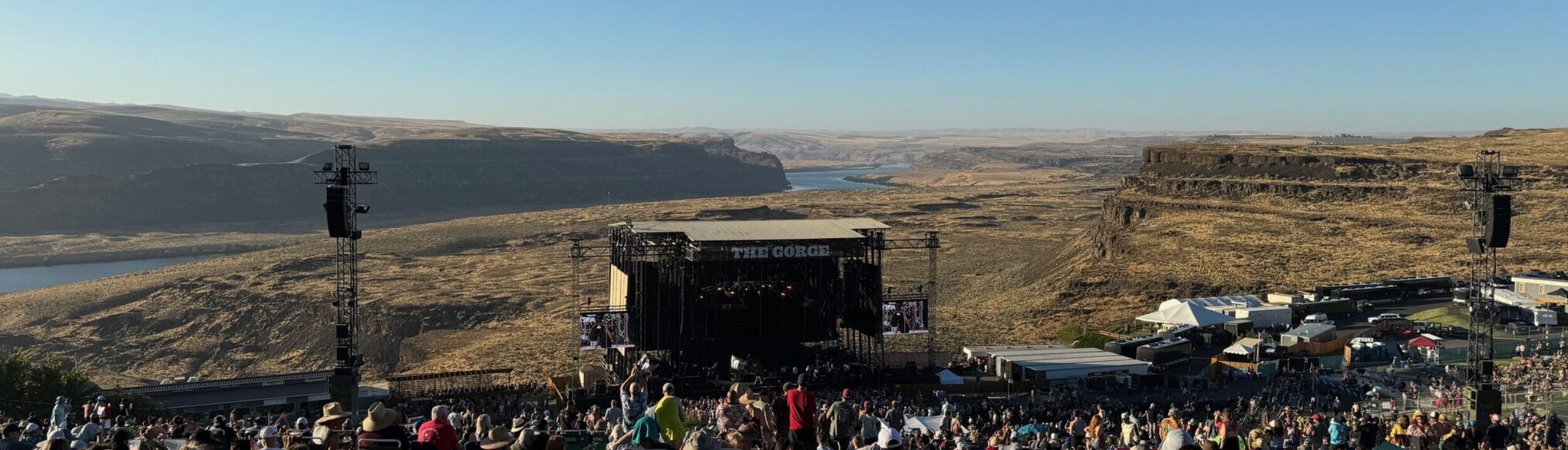
I was really impressed with the quality of this film, not just the performance footage of McLachlan, Sheryl Crow, Natalie Merchant, Paula Cole, Jewel, Bonnie Raitt, and dozens of other artists. There is also fantastic archival footage of the team behind the scenes developing solutions to the problems that seemed to arise every day. And there are good contemporary interviews with the major players who reflect on this time in their lives. Bonus points for this documentary – the first show of the Lilith Fair was at the Gorge in central Washington, otherwise known as Heaven’s Amphitheater, where I’ve seen Dave Matthews Band the last two years. The picture at the top of this website gives you a sense of the beauty of that venue and you can see even more of it by checking out Lilith Fair: Building a Mystery, now streaming on Disney+ and Hulu.
A Fascinating Look at a Flawed Movie – Megadoc
Movie fans around the world were eagerly awaiting the new film from Francis Ford Coppola, when it was released in theaters two years ago. Early screenings of Megalopolis yielded reviews that covered the entire spectrum – some called it a bold masterpiece, others rejected it as a misguided disaster. There was only one consensus opinion – it had to be seen. When I told my son I was planning to see it at our local IMAX theater, he responded, “Well I don’t know if it’s going to be good, but I have to go see it, right?” We both left the theater that night with similar opinions. I admired Coppola bringing this passion project (which he has wanted to make for decades) to the screen, financing the movie with his own money, spending north of $100 million. The story is messy, but there are some really interesting parts to it. Some very good performances, and a few baffling ones. The production design was great. The CGI was a little sloppy. Overall, I’m glad I saw it and there’s a better than 50/50 chance I will watch it again. I am currently making my way through Coppola’s entire filmography and by the time I get to the end, I will likely want to fire up Megalopolis for a second viewing.
Why am I bringing up this controversial movie? Because last year I saw a fascinating documentary about the making of this film that gives us inside access to Coppola, his creative team, and cast who were interviewed during production. Megadoc comes from director Mike Figgis (Oscar-nominated for Leaving Las Vegas) and is an incisive examination of the creative mindset of a Hollywood legend, who still has the professional drive at the age of 85 to deliver a story to audiences. From my standpoint, it looks like Figgis got incredible access, with plenty of interviews with Coppola, stars Aubrey Plaza, Jon Voight, and some very interesting discussions with Shia LaBeouf. There is an interview with Adam Driver, the lead actor of Megalopolis, but it felt like a brief interview, which led me to believe Driver didn’t want to participate in the documentary.
Figgis brings us inside all aspects of the film’s creation – the writing, casting, costume design, production design, and special effects. We even get footage of a table reading of the script from twenty years ago when Coppola originally tried to make Megalopolis. You will do a double take at some of the stars who almost appeared in this movie. In all honesty, when the credits rolled on Megadoc, my immediate thought was “That was fantastic. I wish it was two hours longer.” I wanted to go deeper into the making of a truly unique film from one of our greatest directors. If you have seen Megalopolis, regardless of what you think of it, then you simply must watch Megadoc, which is now available to rent on demand.
The Man is a Genius – Mr. Scorsese
Sometimes I read about an upcoming film and feel an irrational level of excitement. Ooh, a documentary about Martin Scorsese? Fantastic. Oh, wait. It’s a multi-part television series on Apple TV? Well, ok. Wait a minute. The director decided that the story was too big to tell in a two hour film, so she worked with Apple to create a five hour series that explores Scorsese’s life and career? Holy shit! Yes, please!
That was the run of emotions I felt as I learned about Mr. Scorsese, the brilliant film series from Rebecca Miller, which lived up to my high expectations, and then some. Miller was given incredible access to Scorsese, who she interviewed several times throughout this project. She gets him to open up about all aspects of his life – from his childhood growing up in New York, to how he fell in love with movies as a young boy, and how his neighborhood friends influenced his early work. Scorsese doesn’t shy away from the difficult parts of his life. For instance, he discusses the crippling drug addiction which almost killed him. This was during (ironically) a period when he was very successful as a director. He also talks about his relationships, including the ones that didn’t work, and his struggles accepting his role as a father.
Throughout this series, we go through all of Scorsese’s projects and hear about his critical thinking in making the movies, as well as interviews with his contemporary filmmakers and numerous collaborators throughout his career. All of the big names are here to talk about their experience working with him and why they felt passionate about each project. But the most insightful person we hear from is Thelma Schoonmaker, who has edited all of Scorsese’s movies for the last 45 years. She won three Oscars for her work on these films and is the GOAT when it comes to analyzing a scene, which she does multiple times during this documentary.
My one quibble with Mr. Scorsese is that I feel like the last part of Scorsese’s career is rushed through too quickly in the last part of the series. Couldn’t we have gotten a six-hour series that spent more time on his last few films? Oh, well. Beggars can’t be choosers. If you are a fan of movies and Scorsese’s work, this is a must watch. And don’t get intimidated by its five hour runtime. Think of it as a multi-part series that you can watch over the course of several days. Mr. Scorsese is now streaming on Apple TV.
Other Options
Here are a few other documentaries that I previously covered for you to consider for your watchlist. While these next few films might be on the “puff piece” side of the ledger, I truly enjoyed My Mom Jayne, the story of Jayne Mansfield directed by her daughter, actress Mariska Hargitay. Marlee Matlin: Not Alone Anymore was a great look at one of our more talented actresses, and how she overcame numerous challenges in her life and built a successful acting career. And Sally is an overdue and terrific look at Sally Ride, the first woman to travel in space, who lived a complicated personal life few people knew about.
As a movie fan, I’m usually a sucker for the behind the scenes look at how a film was constructed. Wick is Pain is an outstanding look at the building of the John Wick franchise, with terrific breakdowns of the insane stunts featured in those movies and the beating that Keanu Reeves repeatedly took while making them. Last Take: Rust and the Story of Halyna is a very good look at the accidental shooting on the set of Rust, the complicated business of gun safety on movie sets, and a tribute to cinematographer Halyna Hutchins, who was killed in the shooting. Lastly, it’s always fun to go back to Amity and look at Steven Spielberg’s masterpiece that made everyone afraid to go in the water with Jaws @ 50.
You know I’m a music junkie, so of course I’ve got recommendations in this space. Becoming Led Zeppelin is a very good look at the early days of the band, featuring incredible live concert footage. I was fortunate to see this one on an IMAX screen. I just wish it was longer so we could have seen the making of other albums – give us the sequel! If you are even a casual Billy Joel fan, you simply must watch Billy Joel: And So It Goes, which is an extensive look at his career and life (warts and all). Lastly, the best documentary I saw in 2025 was Questlove’s terrific look at some of the most iconic musical moments of the last half century in Ladies and Gentlemen…50 Years of SNL Music.
And one more recommendation. I wrote about Grand Theft Hamlet early last year after it blew me away and I just had to share my thoughts, which you can read here. It’s an unconventional story, but one of the more creative pieces of filmmaking I saw in all of 2025.
That’s all for this week. If you are looking for where to watch some of my recommendations, you can find them at www.justwatch.com. I’ll be back next week with the first half of my top 20 movies of 2025. Thanks for reading and if you would like to be notified about future posts, you can subscribe below.